
SEADOTs brings social-ecological modelling to the Social Simulation Conference 2026
How can we better represent the interactions between people and the ocean in Digital Twin Ocean approaches?
This question was at the centre of SEADOTs’ participation in the Social Simulation Conference 2026 at Durham University, Durham, UK, where researchers working across social simulation, marine systems and Digital Twin Oceans came together to explore new approaches to modelling human–ocean interactions.
SEADOTs participated in the session “Open Data, Agents and the Ocean,” hosted by our sister project SURIMI. The session focused on the representation of social-ecological aspects of human activities related to marine and aquatic environments, and on how social simulation can contribute to tools supporting sustainable ocean management.
As part of the session, Emilie Lindkvist from the Stockholm Resilience Centre, Stockholm University, presented the SEADOTs Baltic Sea case and agent-based model: “Towards Social-ecological Digital Twin of the Ocean: An Agent-Based Model to Explore Interactions Between Pelagic Fisheries, Offshore Wind Farms, and Fish Population Dynamics”. The work is being developed together with Susa Niiranen, Monica Bhattacharya, Alice Boitout, and the wider SEADOTs team.
The presentation introduced an exploratory agent-based model focused on the Baltic Sea fisheries around Gotland and Öland islands. The model brings together herring population dynamics, large- and small-scale pelagic fisheries, fishing regulations and planned offshore wind farms. The prototype is being used for stakeholder engagement and for exploring questions around fishing quotas, offshore wind farms and uncertainty in stock assessments, including how different scenarios may affect herring and sprat biomass and the catches and income of large- and small-scale fishing vessels.
More broadly, the SEADOTs work responds to the challenge of incorporating social, political and economic dimensions into Digital Twin Ocean approaches and asks what kinds of data, variables and processes are needed alongside ecological and oceanographic information.
The conference provided an important opportunity to connect the social simulation and Digital Twin Ocean communities, exchange approaches, and discuss how agent-based and other social-ecological models can contribute to the continued development of the European Digital Twin Ocean.
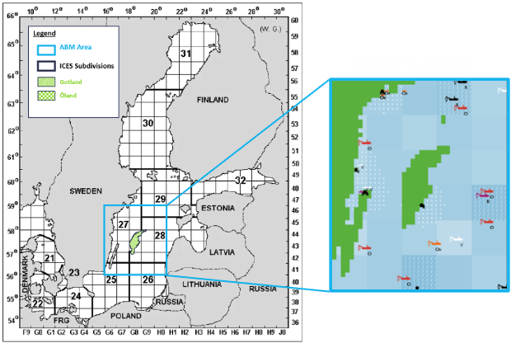
Figure 1. Case study area with ICES regions represented and the agent-based model visual interface.
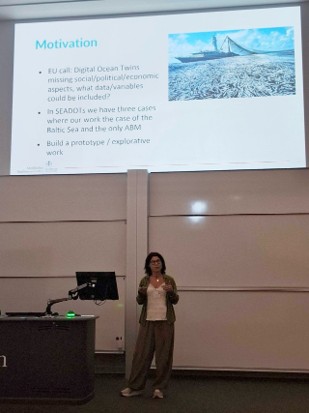
Figure 2. Emilie Lindkvist presenting the SEADOTs Baltic Sea case and agent-based model at the Social Simulations Conference 2026, Durham University, Durham, UK.